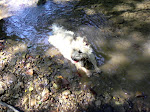
It is 86 degrees Fahrenheit at 8 o'clock, the hygrometer is at 75%, and the water is half way up the storm glass, indicating severe low pressure. In a word, we are waiting for a promised summer storm of significant intensity. Such barometric eccentricities often bring the woods and lakes to life, and tonight is no exception. I was on the back porch reading when I heard the most horrible ruckus from the secret garden. Upon investigation, I found that all four dogs had closed on three raccoons, and the fight was on. Each terrier had engaged a coon directly and violently, and the hound and spaniel were holding the third at the top of a rather largish boxwood. I left the terriers to their business and snagged Nike (Tristan would never understand or accept a stray gunshot wound or significant lacerations from a fight) and Oscar (who is not yet broken to gunshots), and hurried them into the house, where I retrieved my revolver. By the time I returned, both coons on the ground were breathing their last and the third was treed, while the terriers were casting in search of more prey. I dispatched all three vermin and called the dogs in to reward them for their work.
It may seem gruesome to some, but vermin control is a necessary part of country living, as the depredations on my laying flock last week so amply illustrate. And it is good to see a creature do what it is bred and kept to do. The dogs all responded instinctively to the roles to which they were born, and it is a good thing to see creatures fulfill their purpose. I have often wondered if we humans would be a bit more well intentioned toward each other if we lived in a culture or a society which encouraged us to be the creatures and to do the jobs we were created to do, that is, to love the Lord our God with all our heart, soul, mind, and strength, and to love our neighbors as ourselves; and to tend this garden that God has given us. While I am a hopeless romantic, I am not so naive as to believe that humans in agrarian societies are any more humane or well behaved than those who live in cities. History proves otherwise. But it does cause me to ponder what our jobs really are, what we are born to be and to do. I'm not so sure we have done a good job of discerning the answer to that question, and I know we have not lived into the answer as a species.
I believe that we homo-sapiens often believe we have found the answer to the above question, and our answers are generally involved with what some would call finding-one's-self, or being true to one's feelings. I would call such nonsense selfishness of the highest order. I recall being in a rather low grade theological discussion some years back where one of the participants suggested that since he was obviously pre-disposed to a certain type of behavior which the Bible said is sinful, that it made perfect sense to him that he could best glorify God and find fulfillment by being the best practitioner of those predispositions that God had given him. I remember thinking at the time what self-centered nonsense that was, and wondering if he would feel the same if his activity of choice was murder or bank robbery, instead of sexual license. He had in effect rejected the idea of eternal moral imperatives which are self-evident in nature and distilled in Sacred Scripture, in favor of justifying his own predilections in relationship to prevailing cultural norms. The sad thing was that most of the people there agreed with him. Better than half of them were ordained.
I suppose it is my experience with the mental constructions of my fellow humans which makes me value so highly my time with working dogs and horses. They seldom overthink an issue. They may be willfully disobedient, but when it comes to the rat killing or the chase, their instincts kick in and they do what they were born to do without excuse or cowardice. I suppose even the raccoons are only doing what they were bred to do when they eat my chickens and quail. They are worthy opponents who at the end of the day are true to their nature and fight the good fight. O that we humans might so live and die..."facing fearful odds, for the ashes of our fathers, and the temples of our gods." Perhaps then I would want to spend more time with people, and yearn less for the company of good dogs, faithful horses, and the thrill of field sport. Saint Hubert pray for me, a sinner.
A Caveat: Let the Buyer Beware!
While I was cleaning my weapon tonight, I got to thinking. I grew up with Hoppe's #9 Gun Cleaning Solvent. It has a sweet, and far from unpleasant odor, and it has always gotten me to think about things. It is a sort of mental trigger to the mind of a small town Indiana boy. Tonight it got me thinking about the kills that made the cleaning necessary. I shot the raccoons in question with .357 Magnum caliber rounds tipped with 140 grain Barnes expander bullets. They are self defense rounds made to stop a human, or a coyote, or even a deer. (It may sound like a lot of gun for a raccoon, but when only a single weapon is maintained for emergencies, it must be prepared for every possible scenario, not just for raccoons.) The shots were well placed from a distance of three or four feet. Sensation may have stopped instantaneously, but I doubt it. I have killed a lot of game, and there is almost always a lot of thrashing around, gasping, muscle contractions, and the most horrid sounds. It was like that tonight with both of the coons I had to dispatch with a shot. They died clean and quickly, but not instantaneously.
I point this out specifically to dissuade any reader who thinks that killing anything or anyone with firearms or any other weapon is clean, or quick, or without emotion. Movies and TV have made many think that you pull a trigger and the target falls lifeless and that is that. Death is a horrible thing, and killing is a terrible responsibility never to be taken lightly. What is usually portrayed on the screen is a lie, and I hope that anyone reading this who plans to use a firearm for any reason will seek out proper training from qualified personnel, and consider what you are doing. I would suggest that you spend a couple of seasons hunting, so that you can experience the consequences of the thing that you do when you discharge a firearm with the intent to kill. Hunting is a noble pursuit which puts us in closer contact with our food chain and helps us to appreciate what we consume. Lawful defense of family and country are in my opinion the sacred responsibilities of every person. But frivolous and unknowing use of firearms is a curse that has brought too much tragedy into the world. Consider the consequences of your actions, and know the capabilities of the tools you use. I write this as a lifelong hunter and fisherman, a retired soldier, and as a life member of the National Rifle Association.
Showing posts with label ethics. Show all posts
Wednesday, June 12, 2013
Tuesday, September 25, 2012
The Marks of True Christian Faith
![]() |
| The Rev'd John R.W. Stott, M.A., D.D. |
Our Wednesday morning Bible study at St. John's is currently focusing on the Epistles of St. John. Many volumes have been written on these well organized and practical books, but I am regularly drawn back to the writings of the late John Stott in the Tyndale New Testament Commentaries and in Men With A Message, his brief introduction to the New Testament. I have always found his "tests of assurance" to be particularly helpful as I evaluate my own faithfulness to Christ.
1. First is the "christological test" - "This is how you can recognize the Spirit of God: Every Spirit that acknowledges that Jesus Christ has come in the flesh is from God. (I John 4:2)"
2. Second is the "moral test" - "This is how we know who the children of God are and who the children of the devil are: Anyone who does not do what is right is not a child of God. (I John 3:10)"
3. Third is the "spiritual test" - "We know that we have passed from death to life because we love our brothers. (I John 3:14)" "This is how we know that he lives in us: We know it by the Spirit he gave us. (I John 3:24)"
By applying these tests to my life, I can pretty readily determine whether or not Christ is making a difference in my life. And from the evidence, I can gain a rather high level of assurance of the reality of my walk with the Father through the Son and in the power of the Holy Spirit.
But the Rev'd. Mr. Stott also points out that St. John reversed these same affirmations to name and define the spiritual liars such as the Cerinthians who sought to lead the faithful and unsuspecting astray.
1. "Who is the liar? It is the man who denies that Jesus is the Christ. (I John 2:22)"
2. "If we claim to have fellowship with him yet walk in the darkness, we lie. (I John 1:6)"
3. "If anyone says, 'I love God,' yet hates his brother, he is a liar. (I John 4:20)"
"These are the three proofs of genuine Christianity. John brings them all together at the beginning of his fifth chapter: 'Everyone who believes that Jesus is the Christ is born of God, and everyone who loves the father loves his child as well. this is how we know that we love the chldren of God: by loving God and carrying out his commands' (5:1f.). Unless Christians are marked by right belief, godly obedience, and brotherly love, they are counterfeit. They cannot have been born again, for those who are 'born of God' are those who believe (5:1) and obey (3:9) and love (4:7)."
Well said Brother Stott. You leave little space or time for some of the stark denials of the faith received that are in the world today (No more than did St. John the Beloved for those same stark denials which abounded in Asia Minor in the first century.) Might we all apply the truths revealed by God to Blessed John the Evangelist to our lives this day. If we find in that application vindication and proof of our faith, might we give thanks with humility and purpose to continue in the faith received. If we find ourselves wanting in the application, might we humbly submit to God's Word written and ammend our doctrine, and our behaviour, and our lack of love.
all quotations and paraphrases are drawn from Men With A Message by John Stott as revised by Stephen Motyer in 1994. Published in the US by Eerdmans Publishing Co. in Grand Rapids
Labels:
Christian Assurance,
Christian Hope,
doctrine,
ethics,
God's love
Sunday, September 16, 2012
Classical Virtues and True Beauty
Rector's Rambling: October 2012
Sitting here in my chapel/study, I am surrounded by memories. Directly in front of me is a bronze statue of the Minuteman at Lexington (or was it Concord,) presented to me by the members of my regiment upon my retirement. He stands defiant, rifle in hand, alongside a plow over which is draped a cloak. The reference to Livy's account of Cincinnatus is inescapable. On the shelf below the Minuteman are the chief's stripes from my Dad's dress blue Navy Uniform. In the far corner stands another bronze of St. George slaying the dragon, and beneath that stands a stuffed red fox in front of a Joseph Petro print of Bishop Moody blessing the Knox County Hunt (which still needs to be hung after these many weeks.) Behind me is a plaster cast of a Celtic hound, his collar broken, the oppressor's sword clenched between his teeth, and a broken crown beneath his left front paw. Dave Harmon gave it to me when we dedicated the chapel here at Briarwood. Over the altar, in the Romanesque leaded window, stands the Celtic cross my fellow professors presented to me when I left the college to enter chaplaincy and parish work again. Next to me on the wainscoting ledge sits a picture of Rebecca taken when we were in college, sitting on a wall built by her father. There is an Icon of Christ, and another of the Romanov martyrs, and small figurines of Generals Lee and Jackson.
There are so many memories in this room, and yet as I think about them, I realize that they all represent a common heritage and a common philosophy. Tristan expressed it well when he called home last night. He was in the midst of processing a particularly virulent attack on about everything he believes, and needed a sounding board. I was it. The article was a generalized attack on traditional Graeco-Roman concepts of beauty. It maintained that they were merely long established tyrannies of the historic male hegemony which oppressed women and those who did not meet the traditional sculptor's standard of beauty. Tristan responded that in design, good form always follows function, and that certain physical attributes are historically valued because they enhanced performance in a particular realm. Furthermore, to maintain and develop those attributes, certain desirable social qualities are essential, like self-discipline, restraint, hard work, enhanced levels of understanding, and dedication to reaching goals. He added that the article seemed to be written by a person who was unwilling to practice those "virtues" necessary to exhibit that beauty of form which follows and enables human function in its highest expression. In short, the writer was, in his opinion, lazy, undisciplined, unwilling to sacrifice, and far too willing to blame their own rejection on the attitudes of others rather than on their own unwillingness to cooperate with those laws of nature which are self evident; those laws which in an earlier age brought death or slavery to those who ignored them.
I suppose the vast majority of my nick knacks and keepsakes are reminders of what Tristan called "Traditional Values." They remind me of old comrades, of shared sacrifice and hard work, of heroism and the disciplines which preserved freedoms and built empires-spiritual as well as political or economic. In a very real sense, they call me to examine my spiritual life, and to realize that my physical and intellectual lives are important expressions of that "spiritual life" which I value so much. Certainly, my salvation is all of grace. It is freely given by Jesus Christ through the blood of the everlasting covenant. I neither deserve it, nor can I do anything to attain it. But once it becomes the defining feature of my life, I am changed forever, and called to put aside those bad habits of laziness, and thoughtlessness, and selfish lusts of the flesh and mind. I am called to so discipline myself in grateful humility that I do my best to follow the example of who Jesus is and what he does in history. The virtues of temperance, self-control, hard work, personal discipline, dedication, and submission to the revealed will of God- along with so many others, enable me by God's grace to be more like Jesus, that his work might be done in this world.
David Brainerd, the early Puritan missionary to the natives of New England, lamented that God had given him a message to proclaim and a horse from which to proclaim it. By not taking care of his physical health, he said, "I have killed the horse, and now I have no way to deliver the message." His words call us all to pay closer attention to the exercise of the traditional virtues in our lives. God calls us to do our best to develop physical, emotional, educational, and spiritual health that we might be able to serve him more faithfully and fully. It is true that not all of us start with the same raw materials in every area. Some of us have found our abilities to develop in one area or another severely limited by accidents of nature beyond our control or by bad decisions we made in the past. But whatever our situation, we are called in the here and now to do the best we can with what we possess in the present. To labour toward that end is to attain true beauty in both the Classical sense and in the Christian sense.
Thank you Tristan, for reminding me why I kept all of this junk. In the weeks to come, might we all commit ourselves to the practice of those virtues which will help us to build stronger bodies, stronger minds, stronger relationships with each other, and more intimate relationships with Jesus Christ, our Saviour and Lord, my Master.
Faithfully,
Bill+
![]() |
| Phidias: The Cavalcade-Balance, Function, and True Beauty |
There are so many memories in this room, and yet as I think about them, I realize that they all represent a common heritage and a common philosophy. Tristan expressed it well when he called home last night. He was in the midst of processing a particularly virulent attack on about everything he believes, and needed a sounding board. I was it. The article was a generalized attack on traditional Graeco-Roman concepts of beauty. It maintained that they were merely long established tyrannies of the historic male hegemony which oppressed women and those who did not meet the traditional sculptor's standard of beauty. Tristan responded that in design, good form always follows function, and that certain physical attributes are historically valued because they enhanced performance in a particular realm. Furthermore, to maintain and develop those attributes, certain desirable social qualities are essential, like self-discipline, restraint, hard work, enhanced levels of understanding, and dedication to reaching goals. He added that the article seemed to be written by a person who was unwilling to practice those "virtues" necessary to exhibit that beauty of form which follows and enables human function in its highest expression. In short, the writer was, in his opinion, lazy, undisciplined, unwilling to sacrifice, and far too willing to blame their own rejection on the attitudes of others rather than on their own unwillingness to cooperate with those laws of nature which are self evident; those laws which in an earlier age brought death or slavery to those who ignored them.
I suppose the vast majority of my nick knacks and keepsakes are reminders of what Tristan called "Traditional Values." They remind me of old comrades, of shared sacrifice and hard work, of heroism and the disciplines which preserved freedoms and built empires-spiritual as well as political or economic. In a very real sense, they call me to examine my spiritual life, and to realize that my physical and intellectual lives are important expressions of that "spiritual life" which I value so much. Certainly, my salvation is all of grace. It is freely given by Jesus Christ through the blood of the everlasting covenant. I neither deserve it, nor can I do anything to attain it. But once it becomes the defining feature of my life, I am changed forever, and called to put aside those bad habits of laziness, and thoughtlessness, and selfish lusts of the flesh and mind. I am called to so discipline myself in grateful humility that I do my best to follow the example of who Jesus is and what he does in history. The virtues of temperance, self-control, hard work, personal discipline, dedication, and submission to the revealed will of God- along with so many others, enable me by God's grace to be more like Jesus, that his work might be done in this world.
David Brainerd, the early Puritan missionary to the natives of New England, lamented that God had given him a message to proclaim and a horse from which to proclaim it. By not taking care of his physical health, he said, "I have killed the horse, and now I have no way to deliver the message." His words call us all to pay closer attention to the exercise of the traditional virtues in our lives. God calls us to do our best to develop physical, emotional, educational, and spiritual health that we might be able to serve him more faithfully and fully. It is true that not all of us start with the same raw materials in every area. Some of us have found our abilities to develop in one area or another severely limited by accidents of nature beyond our control or by bad decisions we made in the past. But whatever our situation, we are called in the here and now to do the best we can with what we possess in the present. To labour toward that end is to attain true beauty in both the Classical sense and in the Christian sense.
Thank you Tristan, for reminding me why I kept all of this junk. In the weeks to come, might we all commit ourselves to the practice of those virtues which will help us to build stronger bodies, stronger minds, stronger relationships with each other, and more intimate relationships with Jesus Christ, our Saviour and Lord, my Master.
Faithfully,
Bill+
Thursday, June 18, 2009
Belief and Behavior
Rector's Rambling: July 2009
I’ve been reading John and Paul over the last few weeks, and have noticed an entirely predictable pattern. Both of them consider belief and behavior to be very important. What we believe, especially what we believe about Jesus, defines whether or not we are Christians. How we behave is the proof of what we believe.
The Christian believes that Jesus is the only begotten Son of the living God, who lived among us, died for our sins, and was resurrected on Easter to prove forever that God’s power and love are greater than sin and death. Since his glorious ascension into heaven, he is seated in heavenly session, interceding for us and awaiting that day when he shall return to meet us as his own and to vindicate the claims of God forever and ever. There may be some wiggle room about how we interpret and apply these doctrines of the Christ, but they are mandatory components of the faith of the people called Christians. To believe otherwise and yet call oneself “Christian” is somewhat akin to calling a dog a horse, or a chicken a boy. They may have the same number of legs, and may resemble each other in several important ways, but they remain nevertheless separate species. Definitions do matter, and we as individuals are only kidding ourselves if we reject commonly agreed upon definitions in favor of our own wants and desires. To do so is to install ourselves as the arbiters of truth, and such an installation is fraught with dangerous results, including arrogance and exaltation of ourselves to the place of God.
Behavior, the second teaching of the Apostles, has an equally important role in the life of the Christian. Both John and Paul preach that if God has truly transformed our lives, if he has truly brought us from death to life, it should show in the way we interact with each other. While none of us are perfect in this world, we should be drawing closer to the ethical example of Jesus every day. Right belief which is true must inevitably lead to right behavior in ever increasing amounts. Our attitudes should be characterized by love for each other, by humility, by a sincere appreciation of our strengths and our weaknesses, by a willingness to prefer others before ourselves, by a desire to serve God by serving others, and by genuine joy. Such attitudes mean that I will respect the property and opinions of others, even when I believe they are wrong. They necessarily instill in me a strong work ethic and a desire to provide for my own needs and contribute to the relief of suffering in the lives of others. They certainly lead me to exercise restraint and self-control over all of my passions, whether they impact my finances, my relationships, my sexuality, or any other appetite that I may have.
To believe aright and to live in accordance with God’s will are twin indicators of how deep our Christianity really goes. During these dog days of summer, I hope we all might find some time to honestly evaluate how we are doing with our faith, that we might offer ourselves more perfectly to the Father, and become more like Jesus, in the power of the Holy Ghost. AMEN.
Bill+
I’ve been reading John and Paul over the last few weeks, and have noticed an entirely predictable pattern. Both of them consider belief and behavior to be very important. What we believe, especially what we believe about Jesus, defines whether or not we are Christians. How we behave is the proof of what we believe.
The Christian believes that Jesus is the only begotten Son of the living God, who lived among us, died for our sins, and was resurrected on Easter to prove forever that God’s power and love are greater than sin and death. Since his glorious ascension into heaven, he is seated in heavenly session, interceding for us and awaiting that day when he shall return to meet us as his own and to vindicate the claims of God forever and ever. There may be some wiggle room about how we interpret and apply these doctrines of the Christ, but they are mandatory components of the faith of the people called Christians. To believe otherwise and yet call oneself “Christian” is somewhat akin to calling a dog a horse, or a chicken a boy. They may have the same number of legs, and may resemble each other in several important ways, but they remain nevertheless separate species. Definitions do matter, and we as individuals are only kidding ourselves if we reject commonly agreed upon definitions in favor of our own wants and desires. To do so is to install ourselves as the arbiters of truth, and such an installation is fraught with dangerous results, including arrogance and exaltation of ourselves to the place of God.
Behavior, the second teaching of the Apostles, has an equally important role in the life of the Christian. Both John and Paul preach that if God has truly transformed our lives, if he has truly brought us from death to life, it should show in the way we interact with each other. While none of us are perfect in this world, we should be drawing closer to the ethical example of Jesus every day. Right belief which is true must inevitably lead to right behavior in ever increasing amounts. Our attitudes should be characterized by love for each other, by humility, by a sincere appreciation of our strengths and our weaknesses, by a willingness to prefer others before ourselves, by a desire to serve God by serving others, and by genuine joy. Such attitudes mean that I will respect the property and opinions of others, even when I believe they are wrong. They necessarily instill in me a strong work ethic and a desire to provide for my own needs and contribute to the relief of suffering in the lives of others. They certainly lead me to exercise restraint and self-control over all of my passions, whether they impact my finances, my relationships, my sexuality, or any other appetite that I may have.
To believe aright and to live in accordance with God’s will are twin indicators of how deep our Christianity really goes. During these dog days of summer, I hope we all might find some time to honestly evaluate how we are doing with our faith, that we might offer ourselves more perfectly to the Father, and become more like Jesus, in the power of the Holy Ghost. AMEN.
Bill+
Labels:
christianity,
christology,
ethics,
St. John's Episcopal Church
Subscribe to:
Posts (Atom)


